A great cocktail menu design doesn’t just list what you serve — it sells it. The way you organize, describe, name, and visually present your cocktail menu directly determines how much each guest spends per visit. This complete cocktail menu design guide covers the psychology behind high-converting drink menus, the layout principles that consistently lift average check, and how using digital menu boards gives you a competitive advantage that paper menus simply can’t match. Whether you’re designing a new cocktail menu from scratch or refreshing an existing one, these strategies will boost your profits starting with your very next service.
Table of Contents
ToggleWhy Cocktail Menu Design Directly Affects Your Revenue
Menu psychology is real, well-researched, and highly actionable. Cornell University research consistently shows that strategic menu design — the placement, naming, and presentation of items — can lift revenue by 10–20% without changing a single ingredient or price. For a bar doing $500,000 in annual revenue, that’s $50,000–$100,000 in additional sales from better design alone.
Here’s what your cocktail menu design needs to accomplish:
- Guide the guest toward high-margin items — Not every cocktail on your menu makes you the same profit. Good design steers guests toward your Stars.
- Reduce decision fatigue — Too many options cause guests to default to “just a beer.” A tight, well-organized cocktail menu makes choosing easy and enjoyable.
- Communicate your brand — Your menu is a physical extension of your bar’s personality. Craft cocktail bar? Speakeasy? Sports bar? The design should feel like the space.
- Drive upsells naturally — Smart descriptions and strategic item grouping make premium options feel like the natural choice, not the expensive one.
The Anatomy of a High-Converting Cocktail Menu
1. Menu Size and Item Count
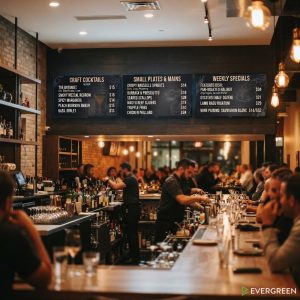
The sweet spot for a cocktail menu is 12–18 signature drinks. Below 10 and guests feel limited. Above 20 and decision fatigue sets in. If you have a large spirits selection, keep the cocktail list tight and use a separate spirits or wine list. Your digital menu boards let you display different sections on different screens — cocktails up front, spirits at the bar, food near the kitchen.
2. The Golden Triangle
Guests reading a menu follow a predictable pattern: their eyes go to the top right, then top left, then bottom. This “golden triangle” is where your highest-margin items belong. In a cocktail menu design, place your Stars — high-popularity, high-margin drinks — at the top and right side of each menu section. Digital menu boards take this further: you can put your featured cocktail front and center on every screen, not just one corner of a paper menu.
3. Naming Strategy
Cocktail names do more marketing work than any other element on your menu. “Whiskey Sour” is functional. “The Midnight Harvest — barrel-aged rye, honey, smoked lemon” is an experience. Evocative names increase order rates significantly and give servers a natural starting point for upselling. Descriptive names also reduce the need for guests to ask questions — which speeds up service and increases table turns.
4. Description Writing
Great cocktail menu descriptions are sensory, not technical. Guests don’t want a recipe — they want to feel how the drink tastes. Focus on flavor, texture, and occasion:
- ❌ “Vodka, lime juice, mint, soda water”
- ✅ “Bright and clean — fresh muddled mint, hand-squeezed lime, and a crisp sparkling finish”
Keep descriptions to 1–2 lines. Any longer and guests skip them entirely.
5. Strategic Grouping
Group your cocktail menu into logical, guest-friendly categories: Classics, Signatures, Seasonal, Zero-Proof. Within each category, lead with your highest-margin item. Digital menu boards let you create distinct sections on different screens — rotating your seasonal menu or happy hour specials without touching the rest of your menu layout.
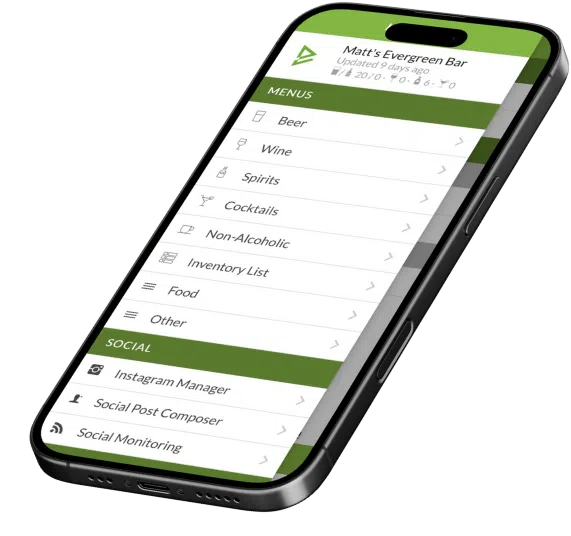
Feature Your Best Cocktails on Every Screen
Join 4,500+ restaurants, bars, and breweries using Evergreen to modernize their menus.
Cocktail Menu Design Principles That Boost Profits
| Design Principle | What It Does | Revenue Impact |
|---|---|---|
| Strategic item placement | Puts high-margin drinks in the golden triangle | +8–12% on featured items |
| Evocative cocktail names | Increases intrigue and order rate | +10–15% on named items |
| Sensory descriptions | Reduces questions, speeds up ordering | +5–8% faster table turns |
| Tight item count (12–18) | Reduces decision fatigue, lifts conversion | +10–20% cocktail orders |
| Digital menu highlighting | Features seasonal and high-margin items on every screen | +15–25% on featured drinks |
| No dollar signs | Removes price anchoring, increases spend | +3–5% average check |
How Digital Menu Boards Transform Cocktail Menu Performance
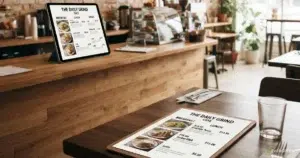
Paper menus are static. A great cocktail menu design shouldn’t be. Digital menu boards give you capabilities that paper simply can’t match:
- Feature your cocktail of the week — Change your featured drink every week without reprinting. Rotate what you’re spotlighting based on ingredient cost, what’s in season, and what your distributor reps are pushing.
- Run happy hour pricing dynamically — Set a happy hour start and end time. Your boards switch to discounted pricing automatically and switch back at the end — no manual changes, no pricing errors.
- Update instantly when something 86’s — When you run out of a garnish or spirit, remove that cocktail from your board in seconds from your phone. No awkward conversations between servers and guests.
- Show photos of your best drinks — A beautifully photographed cocktail on a digital menu board drives orders more effectively than any description. Instagram-worthy drinks on screen = more orders of that drink.
- Sync across all channels simultaneously — Your bar screens, your website menu, and your QR menu all update from one dashboard. One change. Everywhere. Instantly.
According to DSI Digital Signage Research, digital menu boards increase impulse purchases by up to 30% compared to static paper menus — a significant lift for any bar’s cocktail program.
4,500+ Bars and Restaurants Use Evergreen to Sell Smarter
Join 4,500+ restaurants, bars, and breweries using Evergreen to modernize their menus.
Frequently Asked Questions About Cocktail Menu Design
| Question | Answer |
|---|---|
| How many cocktails should be on a bar menu? | 12–18 signatures is the sweet spot. Below 10 feels limited; above 20 causes decision fatigue and slows ordering. |
| What makes a cocktail menu profitable? | Strategic placement of high-margin items, evocative names, sensory descriptions, tight item count, and digital boards that spotlight your best drinks. |
| Should cocktail menus include prices? | Yes, but remove dollar signs — this reduces price anchoring and consistently lifts average spend by 3–5%. |
| How often should I update my cocktail menu? | Seasonally at minimum. Digital menus make weekly or monthly updates effortless — no reprinting required. |
| Do digital menu boards increase cocktail sales? | Yes — research shows digital boards increase impulse purchases by up to 30% compared to static menus. |
| What’s the most important element of cocktail menu design? | Strategic placement of your Stars — high-popularity, high-margin cocktails — in the positions guests look at first. |
Design a Cocktail Menu That Sells as Hard as Your Bar Team Does
Great cocktail menu design is one of the highest-ROI investments a bar operator can make — no new equipment, no additional staff, no extra ingredients. Just smarter presentation of what you’re already pouring. Pair a well-designed menu with Evergreen’s digital menu boards and you can feature, update, and promote your best cocktails in real time across every screen and your website. Join 4,500+ operators running smarter menus. Start your free trial today.
About Evergreen
Evergreen is digital menu software built for bars, restaurants, and breweries. Since 2010, Evergreen has helped 4,500+ operators manage their digital menu boards, website menus, and print menus from a single platform — making menu updates instant and print costs a thing of the past.