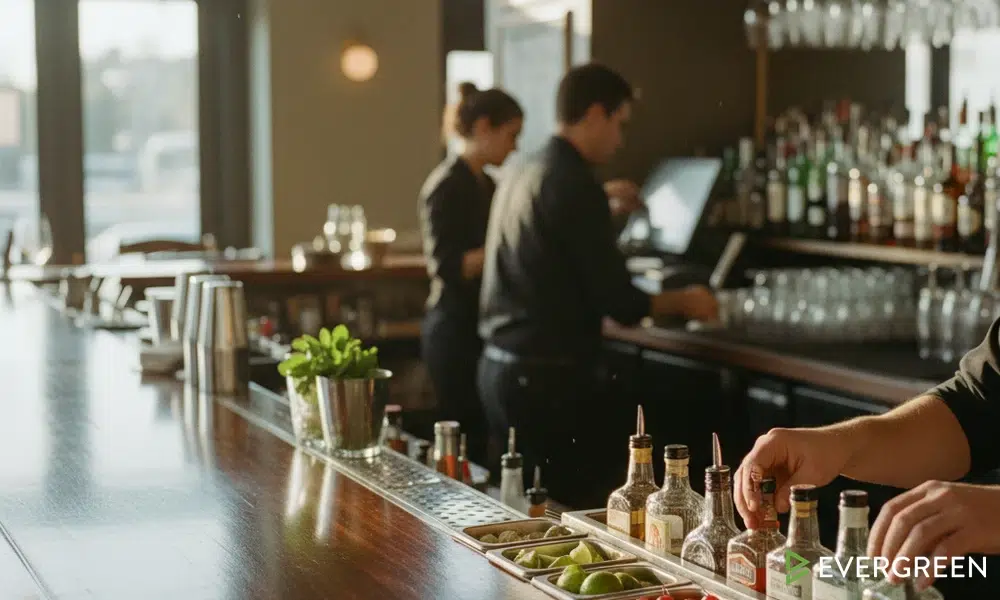
A daily bar opening checklist is the single most important document any bar can have on the floor. It does not matter how experienced your staff is — when there is no structured checklist driving the opening shift, things get missed. A forgotten garnish tray. A keg that never got tapped. A digital menu still showing yesterday’s specials when the first guest sits down. A solid daily bar opening checklist eliminates all of that by turning the chaos of pre-service prep into a repeatable, auditable routine that any staff member can run confidently from day one.
Why Every Bar Needs a Daily Bar Opening Checklist — Every Single Shift
Most bars have a grand-opening checklist or a new-hire onboarding document. What they are missing is a shift-level daily bar opening checklist — the document that runs three hundred times a year, not once. What they are missing is a shift-level document — the daily bar opening checklist that every bartender runs through every single day before the doors open. These are different things. One gets used once. The other gets used three hundred times a year.
The bars that consistently outperform their competition are the ones running tightly systemized shifts. As we covered in Secrets of Successful Bars, the difference between a profitable bar and a struggling one often comes down to whether the team treats opening like a ritual or a chore. A written, signed-off checklist makes that ritual non-negotiable — even when the manager is not in the building.

Bar Owners See Evergreen’s Digital Menu Software in Action
Join 4,500+ restaurants, bars, and breweries using Evergreen to modernize their menus.
According to Toast’s bar operations research, bars that use standardized pre-service checklists experience fewer mid-shift inventory crises and significantly lower staff error rates during peak hours. The investment is a laminated sheet and five minutes of accountability per shift. The return is a smoother service every time.
The Complete Daily Bar Opening Checklist by Station
This daily bar opening checklist is organized by station so responsibilities can be divided among the opening crew. Each section should be initialed by the staff member who completes it.
1. Environment & Safety
- Unlock all entry doors and disable alarm system
- Check all emergency exits are clear and unlocked
- Turn on all lighting — bar, floor, back-of-house
- Inspect restrooms: soap, paper towels, toilet paper restocked
- Sweep and mop bar floor and front-of-house
- Wipe down all bar surfaces, stools, and tables
- Empty and sanitize all drains and drain trays
- Check that hand-washing stations are stocked
2. Refrigeration & Temperature Log
- Record temperatures for all refrigeration units (beer cooler, back bar fridges, walk-in)
- Verify all coolers sealed properly overnight — no gaps, no condensation on seals
- Check that ice machine is running and bin is full
- Pull and discard any product that exceeded temperature or time thresholds overnight
- Rotate stock: new product goes to the back, older product moves to the front
3. Inventory & Stock Check
- Count back bar spirits against par levels — flag anything at or below reorder point
- Verify keg lines are connected and pressurized — pull a test pour on each tap
- Check wine stock against par and restock from storage if needed
- Confirm all speed rail spirits are full and organized in house-standard order
- Stock bitters, syrups, mixers, and garnish containers to par
- Prep garnishes: citrus cut and stored, cherries, olives, cocktail onions fresh and accessible
- Restock straws, cocktail napkins, coasters, and stir sticks

4. Glassware & Equipment
- Run glasswasher cycle — verify clean and streak-free before placing on rail
- Polish and stack all pint glasses, rocks glasses, stems, and shot glasses
- Check all draft beer lines for cleanliness — no off-smells, no buildup
- Inspect and test all cocktail tools: shakers, jiggers, strainers, peelers, muddlers
- POS system powered on, logged in, and tested — all printers loaded with paper
- Credit card terminals online and processing confirmed
5. Menu & Digital Display
This step is where bars using paper menus consistently fall behind. Paper menus cannot update in real time — which means every time something changes, a printed menu becomes a liability. One of the highest-ROI upgrades any bar can make is switching to a digital menu board that updates instantly from any device. Your opening checklist step becomes: open the dashboard, confirm today’s specials are live, verify any 86’d items have been removed, and close the tab. Done in under a minute. No reprinting. No marker scrawling on a chalkboard.
- Update digital menu board with today’s specials and featured items
- Remove any items that are 86’d or unavailable
- Confirm happy hour pricing schedule is set correctly in display system
- Verify all printed menus (if used) are clean, current, and undamaged — replace any that are not
- Check that QR code menu links are resolving correctly
6. Staff Briefing — Final Step Before Service on Your Daily Bar Opening Checklist
- Confirm full shift roster is in-house — contact no-shows immediately
- Review reservation list and any large party bookings for the shift
- Brief staff on today’s specials, 86’d items, and any policy updates
- Assign station responsibilities and confirm section coverage
- Review any customer feedback or complaints from previous shift
How to Make Your Daily Bar Opening Checklist a Non-Negotiable Habit
Writing the daily bar opening checklist is the easy part. Getting the team to actually use it — every shift, without being reminded — is the real work. Here is what the best operators do.
Make it physical and signed. A laminated checklist with a dry-erase marker or a fresh printed sheet that gets initialed and filed each day creates accountability. Digital versions on a tablet work equally well but require a designated device that lives at the bar, not in someone’s pocket.
Tie it to clock-in. The opening team does not start serving until the checklist is complete and signed. No exceptions. This one rule eliminates the “I thought someone else did it” dynamic entirely.
Review it weekly. Your daily bar opening checklist should evolve with your operation. If something keeps getting skipped because it is unclear or takes too long, fix the checklist — not the staff. For a deeper look at building shift systems that run themselves, see our full guide on bar opening and closing procedures.
Connect it to your digital menu. If your bar opening checklist still includes “update the chalkboard” or “reprint specials insert,” that step is costing you 15–20 minutes per shift. Bars on Evergreen’s digital menu platform update their entire board in under 60 seconds from any phone, tablet, or laptop — and the change is live on every screen simultaneously.
Common Mistakes That Happen Without a Daily Bar Opening Checklist
Even experienced bartenders make opening errors when there is no checklist to anchor the shift. These are the most expensive ones.
- Skipping the temperature log. A cooler that ran warm overnight can spoil thousands of dollars of product. Two minutes of logging protects your entire refrigerated inventory.
- Not testing draft lines. Flat beer or off-flavor pours on tap one waste product, two create a terrible first impression for early guests, and three often go unreported because staff do not want to flag the issue.
- Leaving yesterday’s specials up. A guest who orders something that is no longer available — especially from a display — loses trust immediately. This is completely preventable with a digital menu system.
- Skipping the staff brief. Without a pre-shift briefing, servers go into the floor without knowing what is 86’d, what tonight’s specials are, or what tables have special notes. That ignorance shows up in every interaction.
For more on running a tighter, more profitable operation every day, read our full breakdown of the secrets of successful bars that top operators use to consistently outperform the competition. And if you are looking for ways to fill the room once it is open, these bar entertainment ideas are a strong place to start.
Frequently Asked Questions
| Question | Answer |
|---|---|
| What should be on a daily bar opening checklist? | A complete daily bar opening checklist covers six core areas: environment and safety, refrigeration and temperature logging, inventory and stock levels, glassware and equipment, menu and digital display updates, and a pre-service staff briefing. |
| How long does a bar opening checklist take to complete? | With a trained opening crew of two to three people, a thorough bar opening checklist takes 45–60 minutes. Rushing this process is where most mid-shift problems originate. |
| Should bar staff sign off on the opening checklist? | Yes. Having each staff member initial the sections they completed creates accountability and makes it easy to identify training gaps when steps are missed consistently. |
| How do digital menu boards fit into a bar opening checklist? | Digital menu boards replace the manual step of updating chalkboards or printing new menus. A single checklist step — log in, confirm specials are live, remove 86’d items — takes under 60 seconds and updates every screen in the venue instantly. |
| How often should a bar opening checklist be updated? | Review your checklist monthly, or any time a recurring opening issue surfaces. The checklist should reflect how your operation actually runs, not an idealized version of it. |
Start Every Shift Right with a Solid Opening Routine
A daily bar opening checklist is not a sign that you do not trust your staff — it is a sign that you respect their time and your guests’ experience enough to systematize excellence. Print it. Laminate it. Make it non-negotiable. And if your opening checklist still includes manually updating a chalkboard or reprinting a menu insert, that is a sign it is time to modernize your display system.

About Casey Marte
Senior Technical Content & Product Marketing Strategist
Casey Marte is a Senior SEO & Digital Marketing Strategist at EvergreenHQ. With over 14 years of experience across content strategy, search optimization, and now AI-driven marketing, she specializes in making complex digital concepts practical for the operators who need them most.
At EvergreenHQ, Casey brings a data-first mindset to everything from how your business ranks in search to how your brand shows up across platforms. Whether you’re running a single taproom or a growing multi-unit restaurant group, she’s focused on making sure your digital presence works as hard as your team does.