A new restaurant opening checklist is the difference between a smooth launch and a chaotic first week that loses customers before you’ve had a chance to earn them. You need an opening checklist! Opening a restaurant involves hundreds of moving parts across months of preparation — permits, staffing, equipment, training, marketing, and the systems that keep everything running once doors open. Miss one critical step and it shows on opening night.
Most first-time operators underestimate how much coordination is required. You’re not just cooking food, you’re running a compliance-heavy business with perishable inventory, licensed staff, health inspectors, and customers who will share their experience online within hours. Getting it right from day one matters.
Phase 1: Business Foundation (6–12 Months Out)
Define Your Concept and Target Customer
Before anything else, your concept needs to be locked in. Every decision you make from here, from location, staffing, menu pricing, equipment — flows from your concept. A new restaurant opening checklist that doesn’t start here is working backwards.
- Define your restaurant type: fine dining, casual, fast-casual, quick service, or bar-forward
- Identify your target customer and their dining habits
- Establish your cuisine type and core menu direction
- Set your average check target and revenue model
- Research your competition within a 5-mile radius
Legal Structure and Business Registration
You cannot open legally without the right business structure in place. This step takes longer than most new operators expect.
- Choose your business entity: LLC, S-Corp, or sole proprietorship
- Register your business name with the state
- Obtain an Employer Identification Number (EIN) from the IRS
- Open a dedicated business bank account
- Set up your accounting software before any money moves
Secure Funding and Write Your Business Plan
Lenders and investors want a plan — not a concept. A solid business plan that includes financial projections, market analysis, and operational structure is required for most funding sources.
- Outline 3-year financial projections including break-even analysis
- Document startup costs in full: build-out, equipment, licenses, pre-opening payroll
- Identify funding sources: SBA loans, investors, personal capital, or grants
- Budget a contingency reserve of at least 10–15% above your projected build-out cost
Phase 2: Location, Permits, and Licenses (4–8 Months Out)
Choose and Secure Your Location
Location drives foot traffic, rent expense, and customer demographics all at once. Don’t sign a lease before doing this research.
- Analyze foot traffic counts at different times of day and week
- Verify zoning allows food service at your target location
- Review the lease carefully — negotiate rent abatement during build-out
- Confirm parking ratios, ADA compliance, and loading dock access
- Inspect existing infrastructure: hood venting, grease traps, electrical capacity
Permits and Licenses
This is the part of your new restaurant opening checklist that takes the most time and has the most hard stops. Start early and track every deadline.
| Permit / License | Issuing Authority | Notes |
|---|---|---|
| Business License | City or County Clerk | Required before operations |
| Food Service Permit | Local Health Department | Requires inspection before opening |
| Liquor License | State ABC Board | Can take 60–120 days |
| Certificate of Occupancy | Building Department | Required after build-out |
| Sign Permit | City Planning / Zoning | Often overlooked until too late |
| Music License | ASCAP / BMI / SESAC | Required if playing licensed music |
| Fire Safety Permit | Local Fire Marshal | Hood suppression system inspection |
| Food Handler Certifications | State Health Dept | Required for all food prep staff |
Insurance Coverage
Restaurant insurance isn’t optional — a single incident without proper coverage can end your business before it starts.
- General liability insurance (minimum $1M per occurrence)
- Property and equipment coverage
- Workers’ compensation (legally required in most states)
- Liquor liability if you’re serving alcohol
- Business interruption insurance
Phase 3: Design, Build-Out, and Equipment (3–6 Months Out)
Kitchen Design and Equipment
Your kitchen layout determines your speed of service. Work with a kitchen design consultant and cross-reference your menu — every station needs to flow with your concept.
- Design kitchen flow to minimize steps between stations
- Spec all equipment to your menu output needs, not just general capacity
- Confirm hood system size and ventilation requirements with your local fire marshal
- Source both new and certified refurbished equipment to manage startup costs
- Verify all equipment has NSF certification for commercial food service
Front-of-House Setup
Guests form their first impression in the first 30 seconds. Your dining room, lighting, and signage have to communicate your brand before the food arrives.
- Finalize floor plan: seating capacity, table spacing, ADA pathway clearances
- Select furniture that matches your concept and holds up to daily use
- Plan your lighting zones: ambient, task, and accent
- Install your POS system and test with your full menu loaded
- Set up your digital menu boards — this is where Evergreen makes it simple
One operator who opened a 60-seat fast-casual spot found that having their digital menu boards live and updated during their soft opening week directly reduced order errors — staff could point customers to real-time pricing and item availability instead of having to memorize daily updates. The menus updated in seconds from a phone.
Phase 4: Menu, Suppliers, and Systems (2–4 Months Out)
Finalize Your Menu
Your opening menu should be tighter than you think. New kitchen teams need consistency — too many menu items during the first months creates bottlenecks that hurt service quality and food cost.
- Finalize your opening menu at 60–70% of your long-term menu size
- Run menu engineering analysis to identify high-margin, high-demand items
- Cost out every dish — know your food cost percentage per plate before you price it
- Build recipes and plating specs for every item and train to them
- Design your printed and digital menu layouts together for consistency
Set Up Supplier Relationships
Reliable suppliers are as important as your kitchen equipment. Vet multiple vendors for your core categories and negotiate payment terms before you open.
- Secure primary and backup vendors for produce, protein, dairy, and dry goods
- Negotiate delivery schedules that match your prep days
- Set up a purchase order system from day one — track every dollar of food cost
- Establish credit terms with at least your top 2–3 vendors
Technology and Operations Stack
Your tech stack directly affects how efficiently your team operates and how fast you can identify problems. Set these up well before staff training begins.
| System | Purpose | Priority |
|---|---|---|
| POS System | Orders, payments, reporting | Essential |
| Digital Menu Boards | Guest-facing menu display, upselling | Essential |
| Reservation System | Table management and waitlists | High |
| Inventory Management | Food cost tracking and ordering | High |
| Scheduling Software | Staff scheduling and labor management | High |
| Online Ordering Platform | Takeout and delivery revenue | Medium |
| Review Management | Google and Yelp monitoring | Medium |
Phase 5: Hiring and Training (6–10 Weeks Out)
Build Your Core Team
Your opening team sets the culture. Hire for attitude first — especially for front-of-house roles where guest interaction is constant.
- Hire your kitchen leadership (head chef or kitchen manager) at least 8 weeks out
- Staff your front-of-house: servers, hosts, bartenders, and bussers
- Hire slightly above your day-one needs — expect some turnover in the first 60 days
- Verify all food handler certifications and responsible alcohol service certifications
- Set up payroll, direct deposit, and I-9/W-4 documentation before first shifts
Training Program
A structured training week is non-negotiable. Your staff needs to know your systems, your menu, your service standards, and your brand before a single guest walks in.
- Run classroom-style training on menu knowledge, allergens, and specials
- Hold timed mock service sessions to identify flow problems before they happen
- Train all staff on POS operations, void and comp procedures, and end-of-shift close
- Conduct at least one full dress rehearsal with friends-and-family soft opening
- Debrief after every training session — your team will surface problems you haven’t spotted
Phase 6: Marketing and Pre-Opening Buzz (4–8 Weeks Out)
Build Your Digital Presence
Guests will search for you before you open. If there’s nothing to find, you’ve already lost part of your audience.
- Claim and fully complete your Google Business Profile — set opening date and hours
- Create and post consistently on Instagram and Facebook with behind-the-scenes content
- Build a simple website with your menu, location, hours, and reservation link
- Set up and verify your Yelp for Business listing before opening
- Capture email addresses with a pre-opening landing page
Pre-Opening Marketing Checklist
- Post your grand opening date with a countdown on social media
- Reach out to local food bloggers and media with a press kit
- Plan a soft opening event for friends, family, and local influencers
- Set up your online ordering or reservation system and test it end-to-end
- Create a grand opening promotion — first-week special, free dessert, or loyalty signup
Phase 7: Final Preparations (1–2 Weeks Out)
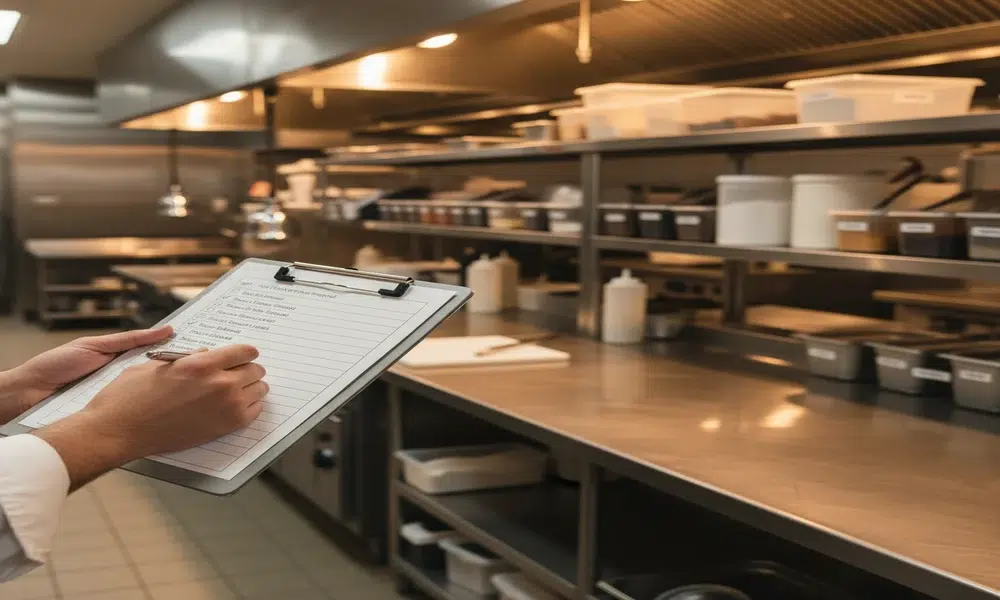
Health Inspection Readiness
A failed health inspection will delay your opening and damage your reputation before you’ve even started. Run your own inspection first.
- Verify all refrigeration and freezer units are holding correct temperatures
- Confirm hot holding equipment maintains 135°F or above
- Check handwashing station supplies at every station
- Confirm food storage is labeled, dated, and properly separated (raw below ready-to-eat)
- Review your local health department’s inspection checklist and walk the space yourself
Final Walk-Through Checklist
| Area | Checklist Item | Status |
|---|---|---|
| Front of House | All tables set, menus staged or digital boards live | ☐ |
| Bar | Speed rails stocked, garnishes prepped, POS tested | ☐ |
| Kitchen | All stations stocked, equipment tested at temp | ☐ |
| Technology | POS, digital menu boards, WiFi all confirmed live | ☐ |
| Staff | Schedule posted, uniforms issued, roles confirmed | ☐ |
| Compliance | All permits posted, certifications on file | ☐ |
| Inventory | Opening par levels stocked, delivery schedule confirmed | ☐ |
| Marketing | Opening announced, reservation system live | ☐ |
Grand Opening Day Protocol
Opening day is a controlled stress test. Plan for problems and have contingencies ready.
- Arrive 3 hours before doors open for a full team walk-through
- Hold a 15-minute pre-shift meeting: review the menu, specials, and any operational notes
- Have a manager stationed at the door to manage wait times and first impressions
- Run your kitchen at 80% capacity for the first service — better to be slightly undersold than to drown the line
- Collect feedback from guests and staff immediately after service
Post-Opening: First 30 Days
Most restaurants that fail do so because the post-opening correction phase gets ignored. Your first 30 days will reveal exactly what your systems missed.
- Review daily sales reports and compare against projections
- Track food cost weekly — variance from your recipe costing signals a problem
- Monitor online reviews daily and respond within 24 hours
- Hold weekly team meetings to surface operational friction
- Adjust your digital menu board layout based on what’s selling and what isn’t — Evergreen lets you update in real time from any device
Frequently Asked Questions
| Question | Answer |
|---|---|
| How long does it take to open a new restaurant? | Most restaurant openings take 6–18 months from concept to doors open, depending on build-out complexity, permit timelines, and funding. |
| What permits do I need to open a restaurant? | At minimum: a business license, food service permit, certificate of occupancy, and fire safety permit. If serving alcohol, add a liquor license, which can take 60–120 days to process. |
| How much does it cost to open a restaurant? | Average startup costs range from $175,000 for a small fast-casual concept to over $750,000 for a full-service build-out. Always budget a 10–15% contingency reserve. |
| What’s the most common mistake on a restaurant opening checklist? | Underestimating permit timelines. Liquor licenses and health inspections create hard stops — missing them delays your entire opening date. |
| Do I need digital menu boards for a new restaurant? | Not required, but operators using digital menu boards report fewer order errors, higher average checks, and easier menu management — especially important when your opening menu is still evolving. |
| When should I start hiring for a new restaurant? | Start recruiting 8–10 weeks before opening. Your kitchen leadership should be hired first, with front-of-house staff coming in 4–6 weeks out for training. |
Set Up Your New Restaurant for Long-Term Success
Every phase of this new restaurant opening checklist builds toward the same goal: a restaurant that runs clean from day one. Permits, staffing, equipment, training, and marketing all have to land in the right order. Operators who follow a structured process don’t just survive the first year — they build businesses that grow. Evergreen helps new restaurants get their digital presence and menu systems right from the start. Start your free trial or book a demo today.

About Casey Marte
Senior Technical Content & Product Marketing Strategist
Casey Marte is a Senior SEO & Digital Marketing Strategist at EvergreenHQ. With over 14 years of experience across content strategy, search optimization, and now AI-driven marketing, she specializes in making complex digital concepts practical for the operators who need them most.
At EvergreenHQ, Casey brings a data-first mindset to everything from how your business ranks in search to how your brand shows up across platforms. Whether you’re running a single taproom or a growing multi-unit restaurant group, she’s focused on making sure your digital presence works as hard as your team does.